The Russian Revolutions of 1905 and 1917
Written by Alan Woods
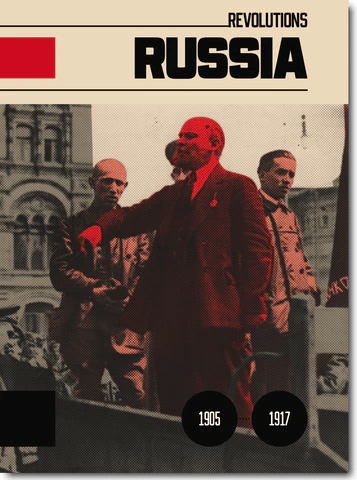
The Russian Revolution of 1905: The Dress Rehearsal for October
Lenin stated that the October Revolution of 1917 could never have taken place without the previous experience of the Revolution of 1905. A study of this remarkable event is therefore of great importance for anyone who wishes to understand the dynamics of revolution in general, and not just in the particular case. We publish here Alan Woods’ introduction to the forthcoming Spanish edition of Trotsky’s 1905.
Lenin wrote that the October Revolution of 1917 would never have taken place without the previous experience of the Paris Commune, the February 1917 Revolution, and the Revolution of 1905. All these revolutions provide us with a very rich treasure house of experience and deserve thorough study. And the present work by the great Russian revolutionary Leon Trotsky, the Chairman of the Petersburg Soviet in 1905 and one of the principal actors in this tremendous historical drama, is by far the most important work on this subject.
In my book Bolshevism – the Road to Revolution, I wrote:
”[…] The first Russian revolution unfolded on an epic scale, involving every layer of the proletariat and all other oppressed layers of society, passing through every imaginable phase of struggle and utilising every conceivable fighting method, from economic strikes and petitions to the authorities through the political general strike and mass demonstrations, to an armed insurrection. The 1905 revolution already revealed, albeit in an embryonic fashion, all the basic processes which were to be repeated on a higher scale 12 years later. It was a dress rehearsal, without which the final victory of the proletariat in October 1917 would have been impossible. In the course of 1905, all ideas, programmes, parties and leaders were put to the test. The experience of the first revolution was decisive for the future evolution of all the tendencies in Russian Social Democracy.”
A study of this remarkable period is therefore of great importance for anyone who wishes to understand the dynamics of revolution in general, and not just in the particular case. Needless to say, such an understanding is only possible for those who have thoroughly grasped the method of Marxism known as historical materialism.
The most striking aspect of a revolution is the speed with which the masses learn. In general, the working class does not learn from books but from life itself. Events, especially great events, are necessary to permit the masses to throw off the heavy burden of tradition, habit and routine and to embrace new ideas. Such is the position taken by the materialist conception of history, which was brilliantly expressed by Karl Marx in the celebrated phrase “social being determines consciousness.” Idealists have always presented consciousness as the motor force of all human progress. But even the most superficial study of history shows that human consciousness always tends to lag behind events. Far from being revolutionary, it is innately and profoundly conservative.
Most people do not like the idea of change and still less of a violent upheaval that transforms existing conditions. They tend to cling to the familiar ideas, the well-known institutions, the traditional morality and religion. Those who call the existing order into question are never popular with their contemporaries. Karl Marx, Socrates, Jesus Christ, Mohammed, Copernicus and Galileo – all were rejected, persecuted and cast in the role of heretics until subsequent events exposed the unsoundness of the old order and led it into a complete impasse and eventual overthrow. We see this dialectical process very graphically in the events of 1905, which Lenin described as a dress rehearsal for the October Revolution of 1917. War and revolution
The stormy events of that period were connected with the Russo-Japanese War of 1904-5. The ambitions of Russian Tsarism in Asia clashed with the westward thrust of the young and vigorous Japanese imperialism, which led it to invade Manchuria and push against the borders of Russia in the Far East and Siberia. The war rapidly exposed the inner rottenness of Tsarism, which suffered a series of humiliating defeats, culminating in the fall of Port Arthur. Here, not for the first or last time, war acted as the catalyst for revolution.
Pacifists always bemoan the evils of war. From the standpoint of abstract humanitarianism no sane person would deny that wars are the cause of immense human suffering, death and destruction. And yet wars have always played a prominent role in history – so much so that we tend to date major historical periods in terms of wars and revolutions (which are a kind of war). The tearful complaints of pacifists (who were around even in ancient Greece) do not appear to have had a noticeable effect in changing this state of affairs. Moreover, it is often those who most loudly proclaim the cause of peace who turn out to be the biggest warmongers. It is sufficient to name George W. Bush and Tony Blair in this context.
Moreover, not all wars have a reactionary character. Few people today would deny the progressive significance of the American War of Independence or the American Civil War in the 18th and 19th centuries, although many of the admirers of these bloody events refuse to accept the validity of the Russian Revolution and the Russian Civil War, or the war of national liberation fought by the peoples of Vietnam, Cuba or Iraq against US imperialism in our own times.
The war between Russia and Japan had no progressive content, like all the other wars fought between the different gangs of imperialist robbers to determine who should have possession of the world’s markets, raw materials and spheres of influence. But wars, even when they have a reactionary character, nevertheless serve to expose mercilessly the weaknesses in the existing order, laying bare the hidden fault lines that lie beneath the surface of the social fabric and at a certain point throwing great masses into movement. That was the case in 1905, and again in 1917, when it led to the greatest social revolution in history. It was the case in the latter stages of the Vietnam War, and will be again in the case of Iraq, which will inevitably produce explosions at a certain stage – not just in Europe but also in the United States itself.
In the early stages of the first Russian Revolution the masses displayed a certain naivety. This is an inevitable stage that we see in every great revolution. We saw it in the initial stages of the English Civil War in the 17th century. We saw it in the French Revolution of 1789-93. We saw it at the time of the February Revolution in 1917. We saw it again in Spain in 1931, with the fall of the Monarchy and the proclamation of the Republic. And we see it now in Venezuela.
A revolution throws millions of politically inexperienced and untutored masses into the scene of active political life. Indeed, the essence of a revolution consists precisely in this active participation of the masses. In the early stages, they suffer from all kinds of illusions; they do not know exactly where they are going or what they want, though they certainly know what they do not want. A certain amount of confusion is inevitable. Where are the masses supposed to get clarity from? The normal conditions of the workers in capitalist society preclude them from acquiring the necessary ideological tools to carry out a revolution.
The masses learn slowly, from events. They proceed empirically, from a series of successive approximations. Moreover, this process does not move in a straight line: every two steps forward is accompanied by a step back. But the general line is always to the left, from the more moderate to the more radical. This process provides great opportunities to the most revolutionary tendency, which can grow rapidly on condition that it knows how to combine revolutionary audacity with the necessary tactical flexibility and retain its links with the masses at every stage. Weakness of the party
The tasks of the proletariat in the Revolution would have been far easier to achieve if there had existed a strong revolutionary Marxist party before January 1905. But it did not exist. The Russian Social Democratic Party (RSDLP), which stood for Marxism, had split in two in the Second Congress only two years before. The two factions that emerged from the split, the Bolsheviks and Mensheviks, were both very weak on the ground in Petersburg. Their links with the working class were weak. They represented a minority of a minority of activists, and were almost completely isolated. This situation is not unknown in the history of the movement. In fact, it is the norm. As old Engels commented at the end of his life: “Marx and I were always in a minority, and we were proud to be in a minority.”
The old Stalinist histories present a picture of the Bolshevik Party standing at the helm and guiding the Revolution at every stage. The truth is that the beginning of the revolution found the Party in a lamentable state. On the eve of 1905 the Party was seriously weakened by splits and arrests. The internal faction fight had paralysed its activities. This is reflected in the number of Bolshevik leaflets issued in Petersburg in 1904: only 11 for the whole year, as against 55 in 1903 and 117 in 1905.
It often happens that the most politically advanced workers can be divorced from the masses and can lose confidence in them. Years of isolation, of putting forward revolutionary positions and getting no response, of beating one’s head against a brick wall, can give rise to moods of scepticism that can play a most damaging role when conditions begin to change. Hence it has happened more than once that the most militant and revolutionary sections of the activists have been left behind by the masses, who have jumped over their unsuspecting heads. It is even possible that the “revolutionaries” may become transformed at the critical moment into a conservative barrier in the path of the class.
Before the events of January, the local Bolshevik leaders in Petersburg displayed a pessimistic attitude and an ingrained lack of confidence in the workers. The so-called committee-men (and women) showered Lenin with complaints. They saw no evidence of a revolutionary mood among the masses, only backwardness and ignorance. As proof of the hopelessness of the situation they cited the fact that the overwhelming majority of the workers were supporting the reactionary “union” set up by the priest Father Gapon with the support of the Tsarist police chief, Zubatov.
The Menshevik S. Somov (I.A. Pushkin) described the situation in their St Petersburg organisation at the start of the year:
“A very sad picture emerged. Well-functioning organisations were to be found only in the Narva sector, with its 30,000 workers for example, the whole social democratic organisation consisted of six or seven circles of workers of the Putilov and the Railway Car Construction plants (five to six workers in each circle) and the work was conducted according to old-fashioned methods, with long courses in political economy and primitive culture. True, there was also a sector organisation of representatives of the circles, but what it did is hard to determine. Factory life found no echo at all in the circles. The diffuse unrest… that was finding an expression in the powerfully developing Gapon movement in which the yearning of the working masses for broad organisation and class unity was so clearly displayed was ignored as Zubatovism. Moreover, most of the workers belonging to our circle were very young men, just out of apprenticeship and with no influence whatsoever in their factory milieu.”
Years later, after the victory of the October Revolution, when Lenin was trying to explain to the young and inexperienced cadres of the Communist International the basics of Bolshevik tactics, he cited the case of Gapon’s union. In his Marxist classic, Left Wing Communism – an Infantile Disorder, Lenin explained that Communists must always conduct work in even the most reactionary workers’ organizations. He said that the Bolsheviks had worked even in police unions. This reference, which many people do not understand, refers to Gapon’s union, the so-called “Assembly of Russian Factory and Workshop Workers”.
As a matter of fact, this is not entirely accurate. The Bolsheviks in Petersburg actually neglected work in this organization, which they boycotted on the grounds that it was a reactionary police union. So it was, but as Lenin explains, it was necessary to work even in such a reactionary organization in order to tear the workers away from the leadership. Had the Petersburg Bolsheviks taken Lenin’s advice seriously, they would have been in a far stronger position when the Revolution began. But they suffered from the well-known disease of all sectarian ultra-lefts, who imagine that all that is required to build a mass revolutionary party is to proclaim it. Unfortunately, all history shows that the task is rather more complicated than that.
In Left Wing Communism – an Infantile Disorder Lenin wrote:
“Under Tsarism we had no ‘legal opportunities’ whatsoever until 1905. However, when Zubatov, agent of the secret police, organised Black Hundred [the Black Hundreds were a reactionary, anti-Semitic organisation used by Tsarism as an auxiliary arm against the revolutionary movement] workers’ assemblies and workingmen’s societies for the purpose of trapping revolutionaries and combating them, we sent members of our party to these assemblies and into these societies… They established contacts with the masses, were able to carry on their agitation, and succeeded in wresting workers from the influence of Zubatov’s agents.”
Answering the ultra-lefts he wrote:
“To refuse to work in the reactionary trade unions means leaving the insufficiently developed or backward masses of workers under the influence of the reactionary leaders, the agents of the bourgeoisie, the labour aristocrats, or ‘workers who have become completely bourgeois’…
“This ridiculous ‘theory’ that Communists should not work in reactionary trade unions reveals with the utmost clarity the frivolous attitude of the ‘Left’ Communists toward the question of influencing the ‘masses’ and their misuse of clamour about the ‘masses’. If you want to help the ‘masses’ and win the sympathy and support of the ‘masses’, you should not fear the difficulties, or pinpricks, chicanery, insults and persecution from the ‘leaders’ (who, being opportunists and social-chauvinists, are in most cases directly or indirectly connected with the bourgeoisie and the police), but must absolutely work wherever the masses are to be found. You must be capable of any sacrifice, of overcoming the greatest obstacles, in order to carry on agitation and propaganda, systematically, perseveringly, persistently and patiently in those institutions, societies and associations—even the most reactionary—in which proletarian or semi-proletarian masses are to be found.”
Lenin pointed out more than once that the working class is always more revolutionary than the most revolutionary party. This assertion at first sight does not seem to correspond to the facts, and least of all on the eve of the 1905 Revolution. The great majority of the workers were conservative in outlook. They were overwhelmingly religious – which partly explains their boundless faith in Father Gapon. They drank vodka. Most were monarchists who believed unquestioningly in the Tsar. When the Bolsheviks approached the strikers with revolutionary leaflets calling for a Republic, they often tore them up and sometimes beat those who were distributing them. Yet all this was transformed into its opposite in the space of 24 hours.
All the efforts of the police and their union stooges to clamp the workers’ movement into a straitjacket of legal constraints were doomed to failure. The rising tide of discontent, which affected all layers of society in the course of the Russo-Japanese War, began to affect even the most backward strata of the working class. Up to this moment, the opposition to Tsarism had mainly come from the liberal intelligentsia and the students. This is also a law. The intelligentsia cannot play an independent role in the revolution, but it is a sensitive barometer of the tensions building up within the deep recesses of society.
“The wind blows first through the tops of the trees.” The ferment in society was reflected in a ferment of opposition among the intellectuals. The universities became bastions of revolutionary protest, and at a certain stage were opened up to the workers. They became the centre of heated debates of ideas and programmes, an important part of the revolution vividly described in the present book. Bloody Sunday
The working class of Russia made its first decisive entrance upon the stage of history in a peaceful procession, with a petition in its hands and a priest at its head. In their hands they carried, not red flags but religious icons. The aim of the demonstration was to appeal to the Tsar, the batyushka (the “Little father”) to improve their intolerable living conditions.
These workers had no understanding of politics. Many of them could barely read or write. They were former peasants who had only recently emigrated to the cities in search of a better life – a phenomenon that is all too familiar to the masses in most of Latin America, and that is now being reproduced on a vast scale in the teeming cities of China.
This process of rapid development had very revolutionary consequences. By tearing millions of people from conditions of rural backwardness that had remained unchanged for a thousand years, Russian capitalism destroyed the social fabric that had provided a kind of stability and identity to the Russian peasant for centuries. Uprooted from his natural environment, the former peasant was hurled into the seething cauldron of factory life. Under the watchful eye of the overseer he learned discipline and factory organization. He learned to subject himself to the merciless rules of mass production. He therefore learned to cast off the old peasant tradition of individualism and egotism, the narrow loyalties of family, village and clan. He began to think of himself as part of a broader community, the working class, with common bonds of interest and solidarity against the exploiters.
But this class-consciousness as yet had only an embryonic character. The Russian proletariat was still a class “in itself” but not “for itself.” In order to make the qualitative leap to revolutionary class-consciousness, the working class had to pass through a very harsh school – a baptism of fire. This occurred on the ninth of January (in the old pre-revolutionary calendar) 1905, known to history as Bloody Sunday.
The confused consciousness of the masses is clearly expressed by their fervent support for Father Grigorii Gapon. Figures like this always emerge in the first period of the revolution. With his curious mixture of militancy and religion, class struggle and monarchism, it corresponded to the first, confused groping towards consciousness of millions of the most downtrodden layers of society. The son of a peasant himself, he faithfully expressed the confused strivings of this layer in which the desire to fight for a better life in this world is still entangled with religious ideas and belief in the Tsar.
The peaceful demonstration of the Ninth of January was met with a hail of bullets from the serried ranks of police and soldiers. Unarmed men, women and children were cut down without mercy by mounted Cossacks. Nobody knows how many were killed, but the total figure is probably not less than a thousand. This was the work of the Tsar, who earned the nickname of Nicolas the Bloody, but who is now being presented to the public opinion of the world as some kind of saintly martyr of the heartless Bolsheviks.
Every revolution is characterised by lightening changes in the psychology of the masses, in which things change into their opposite. On the night of Bloody Sunday, the very same workers who had previously torn up the Bolshevik leaflets sought out the Bolsheviks (they knew who they were) and besieged them with one insistent demand: “Give us arms!”
People can change. We see this in every strike, when formerly backward and apathetic workers become the most militant and energetic champions of the strike. A revolution is like a strike on a vastly wider scale. Father Gapon was an accidental and contradictory figure. After the Ninth of January, he called for an armed insurrection and even came close to the Bolsheviks for a time. The Soviets and the October Strike
In the next eleven months, the Revolution unfolded through a whole series of stages. New layers of the class were continually drawn into struggle. The soviets – those marvellous organs of workers’ power – were created by the working class as flexible and democratic organs of struggle. In their inception they were simply extended strike committees.
Once again, the local Bolshevik leaders failed to grasp the significance of the soviets. They displayed the same sectarian attitude as they had earlier shown towards the Gapon union. They approached the Petersburg soviet with an ultimatum: the workers must either accept the programme and policies of the Party, or else dissolve. As Trotsky wrote, the workers present merely shrugged their shoulders and proceeded to the next point on the agenda, whereupon, the Bolsheviks walked out of the meeting.
From abroad, Lenin watched the conduct of his comrades with a mixture of frustration and dismay. Unlike them, he understood very well the real significance of the soviets, which he correctly characterised as embryonic organs of workers’ power. He urged the Bolsheviks to participate in the real movement of the masses, and eventually they corrected their mistake. But the damage was already done. The Bolsheviks had lost a lot of ground through their sectarianism.
The key figure in the 1905 Petersburg Soviet was undoubtedly Leon Trotsky, who at that time stood outside both the Bolshevik and Menshevik factions but was politically far closer to the former. In the autumn the revolutionary wave had reached its peak with an unprecedented strike wave. At the head of the movement stood the proletariat, wielding its classical weapon of struggle – the general strike. “In its extent and acuteness,” as Lenin later recalled, “the strike struggle had no parallel anywhere in the world. The economic strike developed into a political strike, and the latter into insurrection.”
Throughout the October general strike and November lockout all eyes were on the St Petersburg Soviet. Here was an extremely broad, democratic and flexible organ of struggle. In the course of the struggle, the soviets gradually increased their functions and representative scope. Through the Soviet, the workers made use of the newly conquered freedom of the press by the simple expedient of taking over the printing presses. They compelled the introduction of the eight-hour day and even instituted workers’ control of production in some factories. They formed a workers’ militia and even arrested unpopular police officers. In addition to numerous other tasks the Soviet published Izvestiya Sovieta Rabochikh Deputatov as its public organ. Throughout all these dramatic events, the author of most of the statements and manifestos of the Petersburg Soviet was Trotsky.
The description of the October Strike, written by one of its key leaders, constitutes one of the most important chapters in the book. Whereas in 1917 there was no general strike, in 1905 the general strike was one of the most important weapons of the working class. It was the means whereby the Revolution measured its own strength, organized itself and disorganized the enemy, while simultaneously mobilizing new layers of the working class in struggle. The December Insurrection
The main weakness of the 1905 Revolution was the fact that the movement of the workers in the cities did not receive help from the peasantry until it was too late. By the end of December the workers of Petersburg, who had been in continual struggle since January, were exhausted. The workers of Moscow now occupied the centre stage. They moved in the direction of an armed insurrection, but unfortunately, the Petersburg proletariat was no longer in a position to come to their aid.
The bloody defeat of the December insurrection in Moscow effectively marked an end to the revolutionary flood tide in the cities. But the Revolution continued to spread long afterwards in the villages. There were peasant uprisings everywhere, accompanied by outbreaks of guerrilla war. But without the victory of the workers in the urban centres, it was doomed to failure. Realising finally that this was no longer on the agenda, Lenin called a halt to guerrilla actions and prepared the Party to face a period of reaction.
The defeat of the 1905 revolution was a severe one. Thousands of revolutionaries were executed, tortured, imprisoned and exiled. The Party, which had grown from a handful to a mass force of hundreds of thousands, was again reduced to a small and persecuted underground organization. There were arguments and splits. Lenin was in a minority of one when he argued against the ultra left policies of the Bolshevik leaders who wished to boycott parliament and refused to conduct legal work in the trade unions.
So bleak was the situation that many young comrades committed suicide, believing that the Revolution was doomed forever. Yet by 1911-12, the reaction had reached its limits and a new revolutionary wave had commenced. It was at this time that Lenin and the Bolsheviks won the leadership of the organized working class in Russia.
How was it possible for Lenin and the Bolsheviks to emerge unscathed from this terrible defeat? Napoleon once said that defeated armies learn well. Lenin refused to be pushed off course by the temporary victory of reaction. He stubbornly defended the fundamental programme, methods, ideas and traditions in a context of universal backsliding, revisionism and apostasy. He was even prepared to break with all his former comrades – people like Bogdanov, Gorky and Lunacharsky – in order to defend Marxist philosophy. Only in this way was it possible to preserve the Marxist party and to guarantee its ultimate victory.
In the past period we have lived through a period of reaction – although nothing on the scale of the reaction of 1907-11. Everywhere we see the same tendency to retreat, to abandon the positions of Marxism and Leninism. On all sides we see the same moods of scepticism and cynicism among the middle class intellectuals, ex-Communists and ex-Lefts. Our answer is the same as that of Lenin and Trotsky in a far more difficult period. We stand firmly for the defence of the ideas, programme and methods of Marxism, the only scientific socialist ideology. And events on a world scale are showing that we are right to do so.
It is said that the darkest hour comes just before the dawn. Beneath the surface of black reaction, imperialist wars and barbarism, new forces are maturing and becoming stronger with every passing day. New revolutionary movements are being prepared, like the developing revolution in Venezuela. Just as in every past revolution they will pass through many phases, with many confused ideas and contradictions. That is not surprising. Is not life itself full of contradictions?
On the basis of their experience, the masses will seek out those ideas and that programme that most faithfully expresses their aspirations and wishes, that most accurately expresses, not just that which is, but that which must be. Only the ideas and programme of revolutionary Marxism can offer to the masses the road they are seeking.
In the struggle for revolutionary ideology, a place of honour is occupied by the marvellous writings of Leon Trotsky. And among these, one of the most important is 1905. I recommend it to the reader with the greatest possible enthusiasm.
(The original page can be found here: https://marxist.com/russian-revolution-1905.htm)
The Russian Revolution: The Meaning of October
Intro
75 years ago this month, an event took place which altered the entire course of human history. For the first time - if we exclude the brief but glorious episode of the Paris Commune - the working people took power into their own hands and began the gigantic task of the socialist re-construction of society.
Now, on the eve of this great anniversary, the masses of the former Soviet Union are faced with the spectre of capitalist counter-revolution. Amidst the most appalling scenes of economic and social chaos, all the dark forces which had been swept aside by the revolutionary flood-tide, are creeping back. Private property, speculation, the Orthodox church, racism, nationalism, pogroms, prostitution, unemployment and inequality - like a swarm of grotesque and poisonous insects from under a stone.
And this is hailed as a “new dawn” by the Western media. People capable of identifying such monstrosities with “progress” are capable of stopping at nothing. No lies are too great for them, no distortion too vile. And the avalanche of lies has already begun.
In order to justify the capitalist system, it is necessary to blacken the name of socialism, and especially of scientific socialism, as expressed in the ideas of Marx, Engels, Lenin and Trotsky. Above all, it is necessary to show that revolution is a bad thing, that it represents a horrible deviation from the “norms” of peaceful social evolution, which inevitably ends in disaster.
Not long ago, we celebrated the 200th anniversary of the French revolution. Despite the fact that this was a bourgeois revolution, despite the fact that it occurred two centuries ago, nevertheless, the ruling class in France and elsewhere could not refrain from denigrating the memory of 1789-93. Even such a distant historical event was an uncomfortable reminder to the rich and powerful of what happens when a given socio-economic system reaches its limits. They even propose to change the terrible words of the “Marseillaise”!
Yet revolutions happen, and not by accident. A revolution becomes inevitable when a particular form of society enters into conflict with the development of the productive forces, which form the basis of all human progress.
One of the greatest books of the twentieth century is Leon Trotsky’s History of the Russian Revolution. This monumental study of the event of 1917 has never been equalled. It is an outstanding example of the use of the method of historical materialism to elucidate the processes at work in society. The events leading up to October are not merely recounted, but explained in a way which has a validity and an application far more extensive than the Russian Revolution itself.
In an effort to discredit the October Revolution, the ruling class, through the agency of its hired hacks in the Universities, has assiduously cultivated the myth that the Bolshevik Revolution was only a “coup d’etat” pulled off by Lenin and a handful of conspirators.
Intervention of the masses
In reality, as Trotsky explains, the essence of a revolution is the direct intervention of the masses in the life of society and politics. In “normal” periods, the majority of people are content to leave the running of society in the hands of the “experts” - the parliamentarians, councillors, lawyers, journalists, trade union officials, university professors, and the rest of them.
Over a period, which may be a protracted period of years or even decades, society may acquire the appearance of a certain “equilibrium.” This is particularly true in a prolonged period of capitalist economic upswing, like that which lasted for nearly four decades after the end of World War Two.
In such periods, the ideas of Marxism are not readily accepted or understood, because they appear to fly in the face of “the facts.” On the contrary, the illusions of the reformists Labour leaders of a slow, gradual, evolutionary change - “today better than yesterday, and tomorrow better than today” - achieve a widespread audience.
However, beneath the apparently calm surface, powerful currents are building up. There is a gradual accumulation of discontent and frustration in the masses, and an increasing malaise among the middle layers of society. This is particularly felt by the intellectuals and students, who are a sensitive barometer reflecting the changing moods of society.
In a marvellously graphic phrase, Trotsky refers to the “molecular process of revolution”, which goes on in uninterrupted fashion in the minds of the workers. However, since this process is a gradual one which does not affect the general political physiognomy of society, it goes unnoticed by everyone - except the Marxists.
In just the same way, the ground appears to be solid and firm under our feet (“as steady as a rock,” as the saying goes). But geology teaches that rocks are by no means steady, and that the ground is constantly shifting beneath our feet. The continents are on the march, and in a state of perpetual “warfare,” one colliding with another. Since geological change is not measured by years or even centuries, but aeons, the continental shifts remain unnoticed except for specialists. But fault-lines build up, subject to unimaginable pressures, which eventually erupt in earthquakes.
Wars and revolutions
Similar fault-lines exist in the best-ordered societies. The sudden eruption of wars and revolutions obey approximately the same laws as earthquakes, and are just as inevitable. The moment inevitably arrives when the mass of people decide that “things can’t go on like this any longer.” The break occurs when the majority move to take their lives and destiny into their own hands. This, and nothing else, is the inner meaning of a revolution.
For the well-fed academic, a revolution is an aberration, a “freak,” a deviation from the norm. Society temporarily goes “mad,” until eventually “order” is restored. For such a psychology, the most satisfactory mental image of a revolution is that of a blind herd which has suddenly panicked, or, better still, a conspiracy hatched by demagogues.
In reality, the psychological changes which occur with extreme abruptness in any revolution, are not accidental, but are rooted in the whole previous period.
The human mind, in general, is not revolutionary, but conservative. As long as conditions are generally acceptable, people tend to accept the existing state of affairs within society. Consciousness tends to lag far behind the changes which occur in the objective world of the economy and society.
Only in the last resort, when there is no alternative, do the majority opt for a decisive break with the existing order. Long before this, they will try by every means to adapt, to compromise, to seek the imagined “line of least resistance.” That is the secret of the appeal of reformist politics, especially in a period of capitalist upswing, but not exclusively.
The October Revolution was the product of the entire preceding period. Before finally opting for the Bolsheviks, the Russian workers and peasants had already passed through the experience of two revolutions (1905 and February 1917) and two wars (1904-5 and 1914-17).
Tsarist Russia, which was numbered as one of the principal imperialist states with a powerful army, was nevertheless an economically backward capitalist power. By the law of combined and uneven development, large-scale industry was established in a handful of centres (mainly Moscow, St. Petersburg, the Western region, Urals and Donbass) as a result of Western investment. However, the vast majority of the population were peasants, sunk in conditions of almost medieval backwardness. In many respects, the social composition of Russian tsarism was similar to that of many Third World countries today.
Despite its numerical smallness, the Russian working class set its stamp on events very early on. In the stormy strike wave of the 1890’s, it announced its existence to the world. From that moment, the “labour question” was to occupy a central position in Russian politics.
The stormy growth of industry in the early years of this century led to a rapid growth of the working class. Unlike Britain, where capitalism experienced a slow, gradual, organic growth for 200 years, the development of capitalism in Russia was telescoped into a couple of decades.
As a result, Russian industry did not have to pass through the phase of handicrafts, small cottage industry, through manufacture to large-scale enterprises. Huge factories were established with the most modern techniques imported from Britain, Germany and the USA. Along with the most modern technology imported from the West, came the most modern and advanced ideas of socialism.
From the 1890’s onwards, Marxism succeeded in displacing the old terrorist and utopian socialist trend of Narodnism as the dominant tendency in the workers’ movement.
Narodniks
The more sophisticated critics of Bolshevism try to draw a distinction between civilised “Western” Marxism, and crude, barbarous Leninism, a product, allegedly, of Russian backwardness.
As a matter of fact, there is little or nothing of a specifically Russian character about the ideas of Lenin, who spent all his life tirelessly combating the Narodniks for their “Russian road to socialism.”
Both Lenin and Trotsky dedicated their lives to the defence of socialist internationalism. Their ideas can no more be considered “Russian” than Marx’s ideas be portrayed as “German.” Lenin and Trotsky developed and expanded Marxism, but defended the fundamental ideas and principles worked out by Marx and Engels from 1848 on.
The first great test for the Russian Marxists came in 1905.
The deep social crisis was brought to a head by the Russo-Japanese war, which ended in a military disaster for tsarism. On the ninth of January 1905, the working people of St. Petersburg assembled, with their families, for a peaceful demonstration on the square of the Winter palace. Their aim was to present a petition to the tsar - the “little father.”
The bulk of these workers, most of whom had only recently come from the villages, were not only religious, but monarchists. The Marxists (or Social Democrats, as they were then called) had very small forces, and were split between Bolsheviks and Mensheviks. When they tried to distribute leaflets denouncing the monarchy, in several places the workers tore up the leaflets and even beat them up.
Yet within nine months the same workers had organised a revolutionary general strike and a soviet, and by the end of the year, the workers of Moscow had risen in armed insurrection.
In all the urban centres the Social Democrats become transformed into the decisive force. The 1905 revolution was defeated in the main because the movement in the countryside only got underway after the workers in the towns had suffered a defeat.
For a number of years (1907-11), Russia was plunged into the dark night of reaction. Yet by 1911-12, there was a new beginning, characterised by a massive strike wave (partly reflecting an upturn in the economy), which, beginning with economic demands, rapidly took on a political character.
During this period the Bolsheviks gained a decisive majority in the organised working class. They broke with the opportunist Menshevik wing in 1912 and set up the Bolshevik Party.
It should be remembered, however, that the Bolsheviks and Mensheviks had been tendencies in the existing traditional mass party of the workers - the RSDLP (Russian Social Democratic Labour Party), and even after 1912, the Bolsheviks still called themselves the RSDLP (B).
First World War
On the eve of the First World War, Russia stood once more on the brink of revolution. It is possible that the Bolsheviks could have come to power then, but the situation was cut across by the outbreak of hostilities in August 1914. During the war, the Bolshevik party was decimated by arrests and exile. The youth, which was the party’s main avenue of recruitment, was conscripted into the army, where the worker element was scattered in a sea of backward peasant soldiers.
In exile, Lenin was in contact with maybe a couple of dozen collaborators. In 1915, at the Conference of socialist internationalists in Zimmerwald, Lenin joked that you could put all the internationalists in the world into two stage-coaches.
At a meeting of Swiss young socialists in January 1917, Lenin said that he probably would not live to see the socialist revolution. Within a few weeks, the tsar had been overthrown, and by the end of the year, Lenin was at the head of the first workers’ government in the world.
How to explain such a dramatic turn of events? Vulgar historians explain revolution as the product of extreme misery. That is one-sided and false. If that were true, as Trotsky explains, the masses in a country like India would always be in revolt. The victory of reaction in the period of 1907-11 was facilitated by the economic crisis which, coming after a political defeat, temporarily stunned and disoriented the workers. As Trotsky predicted, it took an economic revival (1911-12) to allow the movement to recover.
Booms and slumps
In reality, neither booms nor slumps in and of themselves cause revolutions. But it is the rapid successions of boom and slump, the interruption of the “normal” pattern of existence, which provokes general uncertainty and instability, and causes people to question the existing state of things. Even more profound are the shocks caused by wars, which turn the world upside down, uproot millions and compel men and women to shed their illusions and finally stand face to face with reality.
The February revolution was a concrete expression of the fact that the old regime had reached an impasse. As in 1904-5, the sledge-hammer of military defeat served to expose the inner rottenness of tsarism.
But to expose something is not to cause it. The crisis on international finance markets and the run on the pound recently exposed the chronic weakness of the British economy. But the decay of British capitalism has taken place gradually over a period of decades, disguised by the general upswing of the world economy. This was explained by the Marxists decades ago. The difference now is that, under the relentless pressure of world capitalist crisis, the mass of the British people are beginning to wake up to the fact.
Beginning even during the war, the strike movement in Petrograd assumed sweeping proportions at the start of 1917. The mood of discontent emanating from the industrial centres found an echo in the ranks of the army, suffering from defeat and exhaustion. The crisis of the regime anticipated the movement of the masses.
Every revolution begins, not at the bottom, but at the top. Its first manifestation is a series of crises and splits in the ruling class, which feels itself to be in a blind alley, and unable to continue to rule in the old way.
Trotsky expresses it in the following sense: “A revolution breaks out when all the antagonisms of a society have reached their highest tension. But this makes the situation unbearable even for the classes of the old society - that is, those who are doomed to break up.”
The smell of corruption and scandal always hangs around a regime which has outlived itself. The present-day epidemic of political and financial scandals in Britain, Japan, the USA, Italy, are no more an accident than the Rasputin regime at the court of “Nicholas the Bloody,” or the “Pompadour factor” of the Ancient Regime in France.
Cossacks
Despite all its armed might, its police, its Cossacks, its secret police, tsarism fell at the first serious challenge, like a rotten apple in a puff of wind. The army collapsed like a pack of cards, once the workers confronted it with a manifest determination to change society.
The working-class as a whole learns from experience - especially the experience of great events. The experience of 1905, despite the defeat, had left an indelible impression which immediately re-emerged in February with the creation of the Soviets - elected committees of workers and soldiers - which were at the same time organs of struggle and, potentially, organs of a new power.
As has happened many times in history, in the February Revolution, the workers had the power in their hands, but did not recognise the fact. With correct leadership, the working class could have immediately carried out the socialist revolution. But under the leadership of the Mensheviks and Social Revolutionaries, the February revolution ended in the abortion of “dual power.”
Revolution means the explosive entry onto the political stage of millions of men and women with no previous experience of politics, in search of a solution to their most pressing problems.
Inevitably, in the first instance, the masses seek the line of least resistance, the easiest solutions, the well-known political figures, the familiar political parties.
In the case of Russia, the war itself had a fundamental effect on the balance of class forces. Here, the “masses” represented, first and foremost, the peasantry, which had been the backbone of the tsarist army. Up to 1914, the Bolsheviks had the leadership of four-fifths of the organised working class. But that situation was altered by the war.
In the February revolution, the entire balance of class forces was changed by the explosive emergence on the scene of the mass of politically untutored workers, who tended to back the Mensheviks. The decisive element in the equation was the army, and here the peasants had a crushing preponderance. The peasant soldiers, recently awakened to political life, looked, not to the Bolsheviks, but to the “moderate” Socialist leaders the Mensheviks and especially the Social Revolutionaries.
The workers, after the experience of 1905, were fearful of a rupture with the peasants in uniform, and, for the time being, were prepared to wait. The combined weight of the peasantry and the politically inexperienced mass of workers swung behind the Mensheviks and the SRs, reducing the Bolsheviks to a small minority in the first stages of the revolution.
Mensheviks
The masses placed their trust in the reformist labour leaders. And the latter, as always, placed their trust in the “liberal” wing of the bourgeoisie, which in turn, was desperately striving to defend the monarchy and put an end to the revolution. Meanwhile, behind the scenes, the reactionary generals were preparing a counter-coup.
Not for the first or last time, the workers had fought and conquered, only to be cheated of the fruits of victory by their leadership. The SR and Menshevik leaders were obsessed by a single idea: to hand back the power as quickly as possible to the bankers and capitalists.
The Provisional Government which emerged from the February Revolution was a government of landlords and capitalists calling themselves “democrats.” The right-wing Labour (“Trudovik”) leader Kerensky entered the government as Minister of Justice. The war minister was the big Moscow industrialist, Guchkov. The “liberal” Milyukov became Foreign Minister.
Worker activists
The worker activists were deeply distrustful of the government. But among the mass of society there was a wave of euphoria. The masses had illusions in their leaders, and regarded Kerensky as their spokesman in the government.
The prevailing atmosphere of revolutionary democratic intoxication even affected some of the Bolshevik leaders in Petrograd. Lenin was still in exile in Switzerland. The main leaders in Petrograd were Kamenev and Stalin, who succumbed to the pressure for “unity.” Instinctively, the Petrograd Bolsheviks came out against the Provisional Government, which they correctly characterised as a counter-revolutionary government. However, Kamenev and Stalin steered the party into a close alliance with the SRs and Mensheviks, and even proposed re-unification with the latter.
From the exile in Switzerland, Lenin watched the situation with alarm. His first telegrams to Petrograd were utterly intransigent in tone and content: “Our tactic: absolute lack of confidence; no support to the new government; suspect Kerensky especially; arming of the proletariat the sole guarantee; immediate elections to the Petrograd town council; no rapprochement with other parties.”
After Lenin’s return in April, the Bolshevik Party entered into a crisis. This is a law in a revolutionary situation, when the pressure of alien class forces bears heavily upon the party and its leadership: the pressure for “left unity,” the fear of isolation, and the rest.
The tension between Lenin and the majority of the leaders was so great that, immediately after his return, Lenin was compelled to publish his April Theses in Pravda under his own signature.
At the April Conference, where fierce struggle occurred, Lenin warned that, rather than accept the position of Kamenev and Stalin, he would prefer to be alone “like Karl Liebknecht, one against 110” (referring to Liebknecht’s courageous anti-war stand in the parliamentary faction of the German SPD).
Lenin explained that the revolution had not achieved its central objectives: that it was necessary to overthrow the provisional government; that the workers must take power, allied with the mass of poor peasants. Only by these means could the war be ended, the land be given to the peasants and the conditions established for a transition to a socialist regime.
In essence, these ideas were identical to the perspectives brilliantly worked out by Trotsky in 1904-5, and known to history as the “permanent revolution.”
Lenin’s ideas won the day. However, the Bolsheviks remained a minority in the Soviets, and the Soviet leaders - the SRs and Mensheviks - were backing the Provisional Government. And here we see the flexible tactics of Lenin, far removed from ultra-left adventurism. Under the slogan: “Patiently Explain,” he urged the Bolsheviks to face to the Soviet workers to put demands on the reformist leaders, to demand action instead of words, to publish the secret treaties, to end the war, to break with the bourgeoisie and take power into their own hands. If they would do these things, Lenin repeated many times, then the struggle for power would be reduced to the peaceful struggle for a majority in the Soviets.
Taking power
However, the Mensheviks and SR leaders had no intention of breaking with the bourgeois Provisional Government. In reality, they were terrified of taking power, and were more afraid of the workers and peasants than the counter-revolutionary general staff.
The truth was that the Provisional Government was an empty shell. There were only two real powers in the land, and one or the other had to be overthrown.
On the one hand, the Soviets of workers and peasants’ deputies; on the other, the remnants of the old state apparatus, grouped around the monarchy and the general staff, which, under the protective shadow of the Provisional Government, was preparing for a showdown with the Soviets.
Explosive growth
One of the main features of a revolutionary situation is the suddenness with which the mood of the masses can change. The workers learn quickly on the basis of events.
Thus a revolutionary tendency can experience explosive growth, passing from a tiny minority to a decisive force, on one condition; that it combines flexible tactics with implacable firmness on all political questions.
At the beginning, Lenin was derided by his opponents as a hopeless “sectarian,” who was doomed to impotence by keeping out of the “left unity.” However, the tide soon began to flow strongly in the direction of Bolshevism.
In a revolution, Trotsky wrote, “the more extreme always supersedes the less.” The workers come to understand the correctness of the ideas of the revolutionary tendency from their own experience, especially the experience of great events.
These are absolutely necessary in order that the workers convince themselves of the need for a radical transformation of society. The different stages in the growth of consciousness of the class are reflected by the rise and fall of successive political parties, trends, programmes and individuals.
The failure of the bourgeois Provisional Government to solve a single one of the basic problems of society provoked a sharp reaction in the main working class centres, especially Petrograd, where the militant proletariat was combined with the revolutionary sailors (who, unlike the infantry, were usually drawn from the factory proletariat, especially the skilled workers).
The constant increase in prices, the cut in the bread ration, caused a ferment of discontent. Above all the continuation of the war raised the temperature to boiling point.
The workers reacted by a series of mass demonstrations starting in April, which indicated an ever-increasing shift to the left in the mood of the workers. In a parallel move, the forces of reaction attempted to mobilise on the streets, leading to a series of clashes.
Demonstration
The Bolsheviks called a demonstration in April, to put pressure on the reformist leaders, and test the mood of the capital.
Resolutions from the factories and workers’ districts flooded in to the Soviet Executive, demanding a break with the bourgeoisie. Workers came to the local committees asking how to transfer their names from the Mensheviks to the Bolsheviks.
By the beginning of May, the Bolsheviks already had at least one third of the workers in Petrograd.
“Every mass action,” wrote Trotsky, “regardless of its immediate aim, is a warning addressed to the leadership. This warning is at first mild in character, but becomes more and more resolute. By July it has become a threat. In October we have the final act.”
The apologists for the ruling class always seek to present revolution as a bloodthirsty event. The reformist leaders throw in their two-ha’pence, by posing as peace-loving parliamentary democrats. But history demonstrates the falsity of both assertions. The bloodiest pages in the history of social strife occur when a cowardly and inept leadership vacillates at the decisive moment, and fails to put an end to the crisis of society by vigorous action. The initiative then passes to the forces of counter-revolution which are invariably merciless, and prepared to wade through rivers of blood to “teach the masses a lesson.”
In April 1917, the reformist leaders of the Soviet could have taken power “peacefully” - as Lenin invited them to do. There would have been no civil war. The authority of these leaders was such that the workers and soldiers would have obeyed them unconditionally. The reactionaries would have been generals without an army.
But the refusal of the reformists to take power peacefully made bloodshed and violence inevitable, and put the gains of the revolution in jeopardy. In the same way the German Social Democratic leaders handed back the power won by the German workers and soldiers in 1918, a crime for which the whole world paid with the rise of Hitler, the concentration camps, and the horrors of a new world war. Instead of taking power, the Menshevik and SR leaders entered the first coalition government with the bourgeois leaders.
The masses at first welcomed this, believing that the socialist Ministers were there to represent their interests. Once again, only events could bring about a change in consciousness. Inevitably, the socialist ministers became the pawns of the landowners and capitalists, and above all of Anglo-French imperialism, which was impatiently demanding a new offensive on the Russian front.
These same “socialists” who had held a pacifist position earlier, once they crossed the threshold of the Ministry, instantly forgot their Zimmerwald speeches and enthusiastically backed the war. A new offensive was announced. Measures to re-introduce discipline in the army reflected an attempt to re-assert the power of the officer caste. The mood of the workers in Petrograd was near boiling point. As a warning shot and a trial of strength, the Bolsheviks considered an armed demonstration to put pressure on the Congress of Soviets in June.
The party was giving voice to the growing feeling of frustration of the Petrograd workers, summed up in slogans, directed at the reformist leaders of the Soviet: “Take over state power!” “Break with the bourgeoisie!” “Drop the idea of a coalition and take the reigns of power into your own hands!” The idea of an armed demonstration caused an hysterical reaction on the part of the middle-class leaders who launched a campaign of slander, misrepresenting it as an attempted coup. The Menshevik Minister Tsereteli warned ominously that “people who did not know how to use arms must be disarmed.” As a small minority in the Congress of Soviets (which the demonstration was planned to coincide with), the Bolsheviks decided to retreat. The idea of an armed demonstration was dropped. In its place, the Congress of Soviets itself called an unarmed demonstration on July 1st. This attempt to out-manoeuvre the Bolsheviks backfired.
Growth of consciousness
The workers and soldiers came to the “official” demonstration carrying placards with the slogans of the Bolsheviks: “Down with the secret treaties!” “Down with the ten capitalist ministers!” “No to the offensive!” All Power to the Soviets!” In a revolution, even such extremely democratic and flexible organisations as the Soviets were not capable of reflecting the rapid shifts of mood of the masses. The Soviet lagged behind the factory committee, the factory committees lagged behind the masses. Above all, the soldiers lagged behind the workers, and the backward provinces lagged behind revolutionary Petrograd.
The process of the growth of consciousness is never uniform. Different layers arrive at different conclusions at different times. There is always a danger that the more advanced layers of the class will go too far too soon, and become separated from the majority, with calamitous consequences.
Infuriated by the offensive, the most radical sections of the Petrograd garrison were preparing for an armed demonstration. Realising that the provinces were not yet ready for a showdown with the Provisional Government, the Bolsheviks tried to restrain the soldiers, but eventually were compelled to put themselves at the head of the demonstration in order to prevent a massacre.
As the Bolsheviks had warned, the government seized on the opportunity to crack down on the movement, leaning on more backward regiments. The “July Days” ended in a defeat, but thanks to the responsible leadership of the Bolsheviks, the losses were kept to a minimum, and the effects of the defeat were not long-lasting.
A revolution is not a one-act drama. Neither is it a simple, forward-moving process. The Russian revolution unfolded over nine months. The Spanish revolution took place over seven years - from the fall of the monarchy in 1931 to the May Days of Barcelona in 1937. Within the revolution, there are periods of breathtaking advance, but also periods of lull, of defeat, even of reaction.Thus the February revolution was succeeded by the reaction that followed the July Days. The Bolsheviks were accused of being German agents and mercilessly hounded, arrested and imprisoned. Lenin was forced to go into hiding, and then move to Finland.
Counter-revolution
From February onwards, the counter-revolution had been biding its time, hiding behind the coat-tails of the Provisional government. The offensive, and the crushing of the Bolsheviks in July, now tilted the pendulum to the right. The officer caste began serious preparations for a coup d’etat, culminating in General Kornilov’s uprising at the end of August. Only the courageous reaction of the workers and soldiers saved the revolution. The railway workers, risking their lives, refused to drive the trains, or misdirected them. Kornilov’s army found itself without supplies, without petrol, disorganised and disoriented. Agitators, mainly Bolsheviks, got to work among Kornilov’s troops and won them over. Kornilov ended up a general without an army. Reluctantly, the Mensheviks and SRs were forced to legalise the Bolsheviks. But by now the masses had begun to realise the true state of affairs. In an early article on the revolution, written between sessions at the Brest-Litovsk peace negotiations in 1918, Trotsky recalled events still fresh in his mind: “The growth of the influence and strength of the Bolsheviks was undoubted, and it had now received an irresistible impetus. The Bolsheviks had warned against the Coalition, against the July offensive, and had foretold the Kornilov rebellion. The popular masses could now see that we had been right.”
Panicked by the advance of Kornilov’s “savage division,” the reformist Soviet leaders had been compelled to arm the workers. The position of the Bolsheviks now became decisive in the Petrograd soviet. Moreover, the time was growing near for the second All-Russian Congress of Soviets, at which the Bolsheviks were assured of a majority. At one point, the counter-revolutionary policies of the reformist leaders of the Soviets had inclined Lenin to consider dropping the slogan “All power to the Soviets,” and substituting for it the idea of taking power through the factory committees. This fact shows the extreme flexibility of Lenin’s tactics. There was no question of making a fetish out of any organisational form, even the Soviets. However, the Soviet form of direct elections from the workplaces and garrisons represented a far more democratic expression of the will of society than any regime of bourgeois parliamentary democracy known to history.
One of the most blatant lies about October is that the Bolsheviks were “undemocratic” because they based themselves on Soviet democracy rather than a parliament (“Constituent Assembly”). The argument is that Lenin and Trotsky represented, not the masses, but only a small, tightly disciplined group of conspirators. For these critics, October was not a revolution, but a “coup.”
The truth is very different. The Soviet system in 1917 and the years immediately following the revolution was the most democratic system of representation of the people ever known. Even the most democratic models of bourgeois parliamentarianism cannot compare with the simple and direct democracy of the Soviets. Incidentally, the Russian word “soviet” merely means a “council” or “committee.” The Soviets were born in 1905 as extended “strike committees.” In 1917, the workers soviets were broadened to include representation by the soldiers, who were overwhelmingly peasants in uniform. Representatives to the soviets were elected directly by their workmates and instantly recallable. Compare this to the present system in Britain, where parliaments are elected every four years on average. There is no means of recall. Once a parliament is elected, it cannot be removed until the next general election. Governments are free to renege on their promises - and invariably do so, in the knowledge they cannot be removed.
Most of the parliamentarians are professional politicians, with no contact with the people who elected them. They live in another world, with high salaries and expenses which puts them in a different social category to the people they are supposed to represent.
In a revolutionary situation, where the moods of the masses change rapidly, the cumbersome mechanisms of formal bourgeois democracy would be utterly incapable of reflecting accurately the situation. Even the soviets, as we have seen, often lagged behind.
In his 1918 work, Trotsky characterises the democracy of the Soviets in the following way: “They depend on organic groups, such as workshops, factories, mines, companies, regiments, etc. In theses cases, of course, there are no such legal guarantees for the perfect accuracy of the elections as in those to municipal councils and zemstvos (a kind of elected district council in the rural areas under tsarism, AW), but there is the far more important guarantee of the direct and immediate contact of the deputy with his electors. The member of the municipal council or zemstvos depends on an amorphous mass of electors who invest him with authority for one year, and then dissolve. “The Soviet electors, on the other hand, remain in permanent contact with one another by the very conditions of their life and work: their deputy is always under their direct observation and may at any moment be given new instructions, and, if necessary, may be censured, recalled, and replaced by somebody else.”
The right wing socialists tried by all means to prevent the soviets from taking power. First, they organised the so-called “Democratic Conference,” calling for a “responsible ” Ministry. This satisfied no-body, and was attacked from the right and the left. The rapid polarisation between the classes doomed all the manoeuvres of the “centre” to defeat in advance. The endless intrigues and combinations of the politicians contrasted with the desperate position on the front that cold and wet Autumn. The mood in the villages was increasingly impatient. The right wing socialists argued that the peasants should wait for the election of the “Constituent Assembly.” The Bolsheviks demanded the immediate transference of the land to the peasants’ committees. The slogans of “peace, bread and land” won the mass of the peasants over to the side of the Soviets. By October, the stage was set for the last act in the revolutionary drama.
Contrary to a widespread prejudice, revolution is not the same as insurrection. Nine-tenths of the work of the revolution consisted in winning over the decisive majority of the workers and soldiers by patient political work, summed up by Lenin’s slogan:
“Patiently Explain!”
The main blows of the Bolshevik propaganda and agitation were directed, not against the right-wing labour leaders, but against the class enemy - the monarchy, the landowners, the capitalists, the Black Hundreds (fascists), and the liberal bourgeois Ministers in the coalition government.
Bolshevik majority
By October, the Bolsheviks had a clear majority in the Soviets. Trotsky insisted that the date of the insurrection should be timed to co-incide with the opening of the Congress of Soviets, where the Bolsheviks would win the majority of the Executive Committee, and could therefore act with the full authority of the Soviets, which comprised the decisive majority of society.
A point is reached in every revolution where the question of power is posed point-blank. At this stage, either the revolutionary class goes over to a decisive offensive, or the opportunity is lost, and may not return for a long time. The masses cannot be kept forever in a state of agitation. If the chance is lost, and the initiative passes to the counter-revolution, then bloodshed, civil war and reaction will inevitably follow.
This is the experience of every revolution. We saw it in the period of 1918-23 in Germany, and in Spain from 1931-37. In both cases, the working class paid for the crimes of the leadership with a ghastly defeat, the fascist dictatorships of Hitler and Franco and the Second World War, which nearly resulted in the destruction of civilisation.
Such is the importance of leadership that, ultimately, the fate of the Russian revolution was determined by two men - Lenin and Trotsky. The other leaders of the Bolsheviks - Stalin, Kamenev, Zinoviev - repeatedly vacillated under the pressure of middle-class “public opinion” - in reality the prejudices of the upper layers of the middle class, the intelligentsia and educated liberal leaders masquerading as socialists. These leaders represented the first confused, amorphous strivings of the masses to find a way out by the shortest road.
Cruel deception
However, the workers and peasants learned by experience that this alleged short-cut represented a cruel deception. This experience, together with the correct policies, strategy and tactics of Lenin and Trotsky, prepared the ground for the massive shift of opinion in the direction of Bolshevism. This would never have been possible if the line of the conciliators had been accepted.
Lenin was constantly being accused of “sectarianism” by the enemies of Bolshevism - and by a section of the Bolsheviks leaders who wanted a “broad left front” with the Mensheviks and SRs, and were terrified of being “isolated.” This fear was even more pronounced after the experience of July. With the exception of Lenin and Trotsky (who joined the Bolsheviks in the period of reaction during the Summer, together with an important group of non-party Marxists, the Mezhrayontsy), most of the other prominent Bolsheviks favoured participating in the “Democratic Conference” and even in the fake “pre-parliament” which was set up at this Conference - a “parliament” without any powers, elected by nobody and representing only itself.
The old party leaders reflected the past of the workers and peasants, not their present or their future. Finally, the Bolsheviks demonstratively walked out of the “pre-parliament,” to the general applause of the workers and soldiers - and the horror and indignation of the conciliators.
Thanks mainly to the work of Trotsky, the Petrograd garrison was won over to the Bolshevik cause. Trotsky made use of the Military Revolutionary Committee, set up by the reformist-led Executive of the Soviet, to arm the workers in defence against the reactionaries. The workers in the arms factories distributed rifles to the Red Guard. Mass meetings, demonstrations and even military parades were held openly on the streets of Petrograd.
Far from being the work of a tiny, secret group of conspirators, the preparations for the insurrection involved a massive participation by workers and soldiers.
John Reed, in his celebrated book Ten Days that Shook the World gives a graphic eye-witness account of these mass meetings, which were held at all hours of the day and night, addressed by Bolsheviks, left SRs, soldiers recently arrived from the front, and even anarchists. Even in the February revolution, there had been few meetings such as this. And all spoke with one voice: “Down with Kerensky’s government!” “Down with the war!” “All power to the Soviets!”
Revolutionary Petrograd
The power base of the Provisional Government had shrunk practically to nothing. Even those conservative regiments drafted in from the front became infected by the mood of revolutionary Petrograd. The support for the Provisional Government in the capital collapsed immediately the workers began to move. The insurrection in Petrograd was a virtually bloodless affair.
Some years later, the celebrated Soviet director Sergei Eisenstein made a film called October, which contains a famous scene of the storming of the Winter Palace, during which there were a few accidents. More people were killed and injured then than in the actual event! The propaganda of the bourgeois against the October revolution is a crude falsification of history. The actual seizure of power took place smoothly, and with very little resistance. The workers, soldiers and sailors occupied one government building after another, without firing a shot. How was this possible? Only a few months earlier, the position of Kerensky and the Provisional Government appeared to be unassailable. But in the moment of truth, it found no defenders. Its authority had collapsed. The masses deserted it and moved over to the Bolsheviks.
The very idea that all this was the result of a clever conspiracy by a tiny group is worthy of a police mentality, but will not stand a moment’s analysis from a scientific point of view. The overwhelming victory of the Bolsheviks at the Soviet Congress underlines the fact that the right-wing reformist leaders had lost all their support. The Mensheviks and SRs won only one-tenth of the Congress - about 60 people in all. The Soviets voted by a massive majority for the assumption of power.
Lenin moved two short decrees on peace and the land which were unanimously approved by Congress, which also elected a new central authority, which they called the “Council of People’s Commissars,” to avoid the bourgeois ministerial jargon. And power was in the hands of the working people.
A New October
Now, seventy five years later, the film of history appears to be being played in reverse. The Soviet working class has paid a terrible price for the crimes of Stalinism. The collapse of the bureaucratic regime has been the prelude to an attempt to move back to capitalism. However, as Lenin used to say “history knows all sorts of transformations.” On the road of capitalism, there is no future for the working people.
On the basis of their experience, the workers of the former USSR will come to understand that fact. The old ideas, programme and traditions will be re-discovered. The basis will be laid for a new edition of the October Revolution, on a qualitatively higher basis, not only in the former Soviet Union, but on a worldwide scale.
(The original page can be found here: https://marxist.com/the-russian-revolution-the-meaning-of-october.htm)
(Cover design by culture glut llc. https://www.cultureglut.com)